
chris marker
israel at twelve years of statehood

For my birthday, my partner and I took a bus to the Israel Museum atop Givat Ram. They have an exhibition that we both wanted to see, “Chris Marker: The Lost Photographs of Israel” — showcasing still photos taken by the French director during his travels throughout the country in 1960.
Once reaching the end of the display, museumgoers are invited to sit an hour and watch his documentary chronicling the visit, Description of a Struggle. The curators marketed the exhibit, particularly the documentary, as the prescient and insightful work of a detached outsider — “the first documentary about Israel produced by private individuals rather than Zionist institutions.”
Indeed, Marker flew to Israel not on the government’s dime but at the behest of Wim and Lia Van Leer, film enthusiasts who themselves left an indelible mark on Jerusalem’s cultural scene. The couple founded the city’s cinematheque, nestled on the edge of the Hinnom valley, and later started the annual Jerusalem Film Festival, which just wrapped up its 42nd year.
The couple sought from Marker a documentary presenting a cleareyed portrait of Israel, in exhibit curator Gilad Reich’s words, “something artistic and without clichés, witout tractors and the Jewish National Fund, or hospitals or government ministers at ceremonies.”
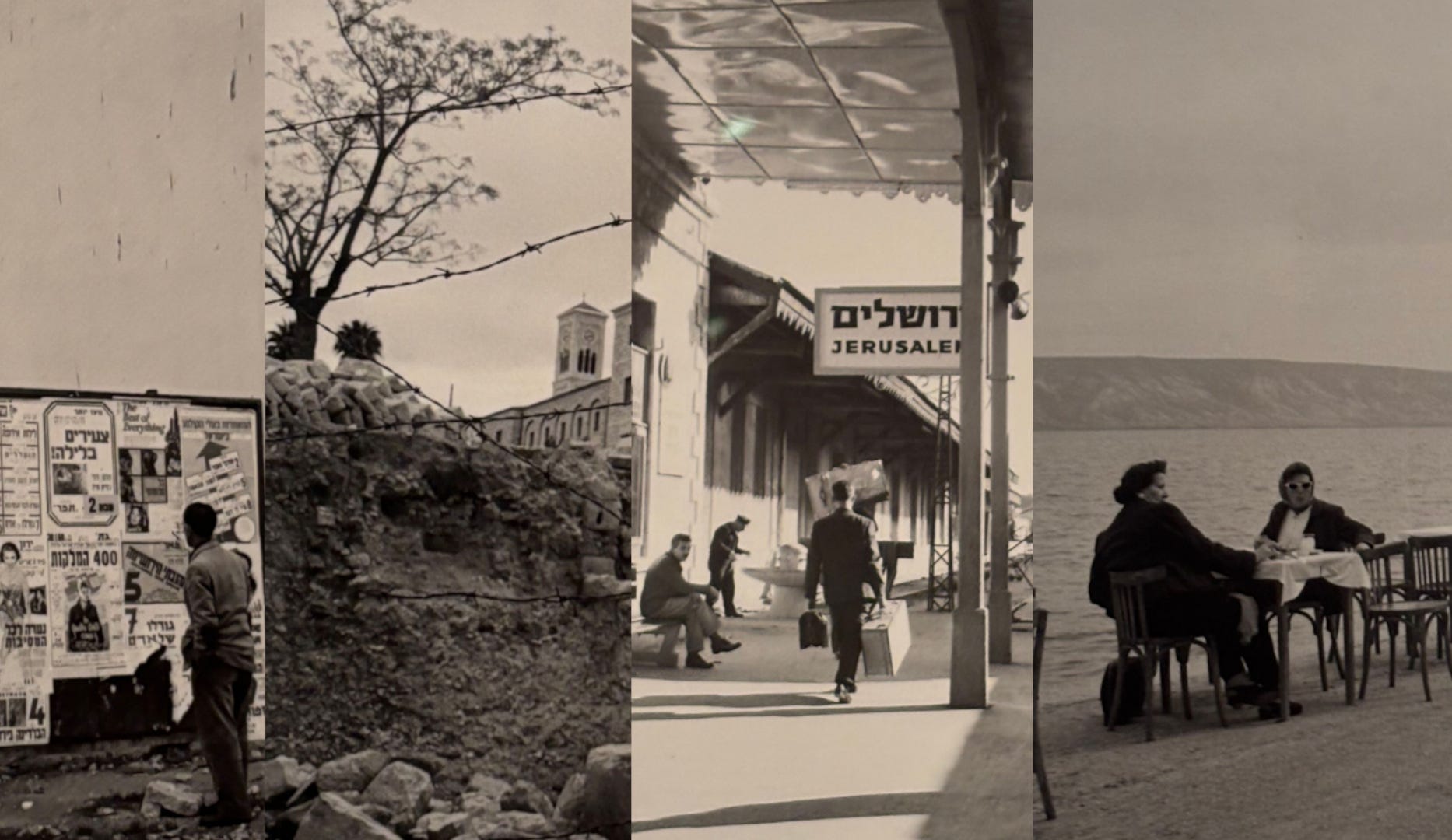
Marker apparently traveled across the country on a Vespa to shoot his documentary, taking photos along the way which were dug up only recently in the Paris Cinematheque’s archive, hence the exhibition’s title — the “lost photos” of Israel. Before sitting down for the film at the back of the room, we scanned the mostly black-and-white still photographs arranged into clusters based on region.
Some of the photos revealed an Israel strikingly different from the country I’ve only known for the past three years — the remnants of Jaffa’s Manshiyya neighborhood, purged of its Arab residents and largely leveled by the Irgun (Etzel) in 1948; the old Jerusalem railway station before it was turned into a second-rate culinary hub; a desolate and barren Mamilla, then home to Mizrahi immigrants — under regular fire from Jordanian forces on the other side of the imposing border wall separating East and West Jerusalem — rather than a hotspot for moneyed tourists.
One of the only scenes immediately familiar to me was Tel Aviv’s Ibn Gabirol Street, flanked by buildings with bulky overhangs which apparently have remained the same for decades.
Out of all the photographs, what caught my eye was that of a monastery framed by barbed wire. The photo seemed to hint at the crucifixion, in my opinion, and was a taste of what I would soon come to recognize in the documentary as the French filmmaker’s inevitably Christian vantage point.
I walked in on the assumption that I would be observing the artist’s work, as one expects from museum exhibits. Instead, I found myself under the microscope, subject to the scrutinizing eye of this Frenchman film director who — contrary to the curator’s description — was certainly not opposed to clichés, particularly when it came to the Jewish people.
Now I don’t want to scold Marker. Drawing on public’s general preconceptions is a crucial part of the storyteller’s work, and writers who try to eschew this would probably do better as academics. I only mention clichés because, underlying the documentary’s overdrawn adages about the Jews is Marker’s insight and keen attention to detail, enabling him to touch on sensitive questions related to collective Jewish existence.
Around 20 minutes into the film, I turned to my partner and half-jokingly whispered to him in the darkened room — “I feel as if I’m being watched.” In retrospect, I felt I was watching a wildlife documentary. The narrator attempts to analyze Israelis’ group behavior and attributes the cause of said behavior to the Jewish people’s ostensibly unchanging traits. What prompted my comment is the following narration:
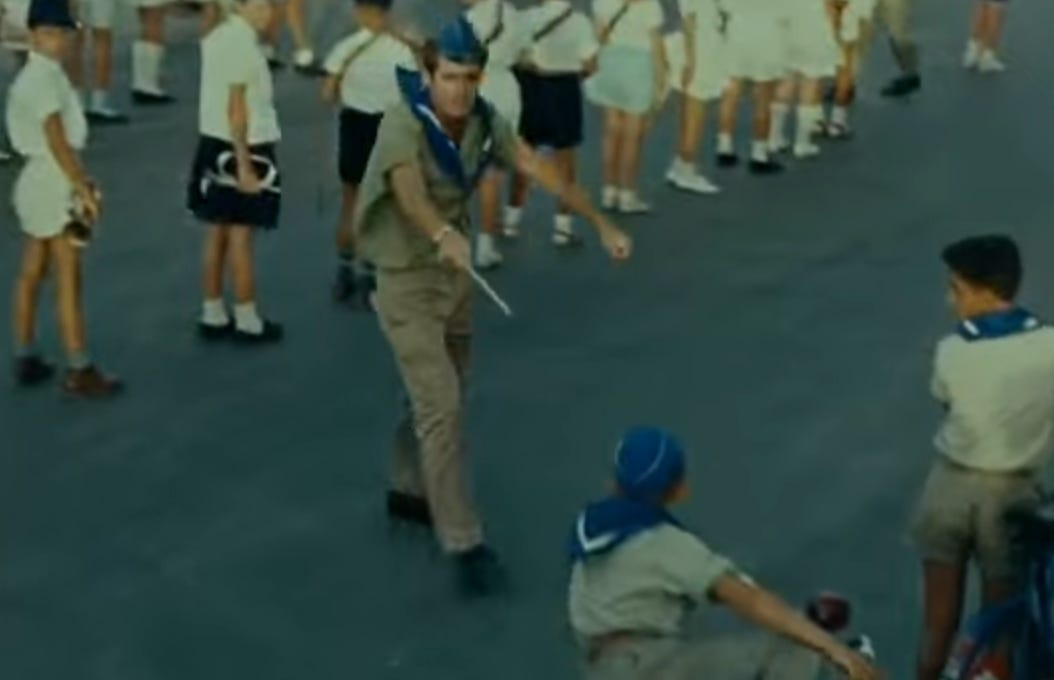
“And so it came to pass, disguised as tailors and bankers, the shepherds returned. They built cities, struck out on the roads, but after centuries of confinement, their shepherding instincts overflowed into other fields. Education, for example…”
The B-roll cuts to a scene of children decked out in khaki uniforms, blue kerchiefs around the neck and side caps to match. They appear to be rehearsing ahead of a youth movement parade as their instructor shouts at them, waving a white stick as he steers his flock to and fro.
Marker, one of the leading directors associated with the French New Wave movement of the late 1950s-60s, doesn’t feign objectivity in his documentary. His voice in the movie — probably best described as a “film essay” — isn’t that of an omniscient narrator but an observer with his own thoughts and opinions, sense of humor and historical awareness. The documentary flows freely, with scenes linked based on certain abstract ideas rather than location, unlike the geographic logic of the exhibit itself.
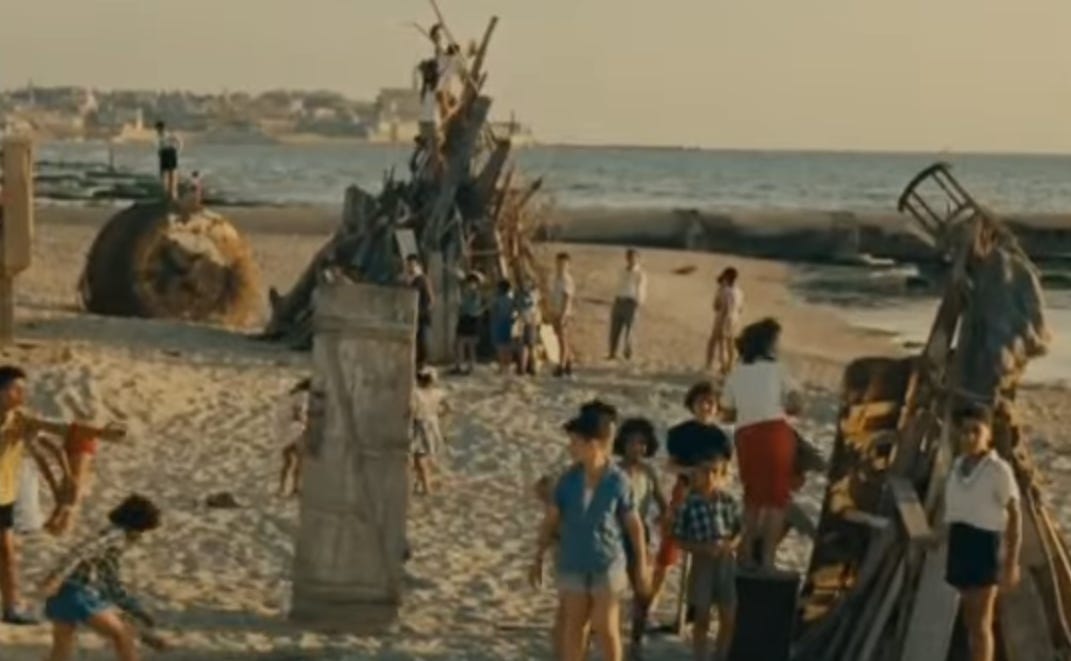
For my partner, the exhibit tapped into his romantic impulse and harked back to a “purer” time — before American culture began to permeate Israeli society, before the occupation of the West Bank. Children ran wild with no adult supervision building bonfires on the beach, and kibbutzim were in their heyday, before the wave of privatization swept over the socialist cooperatives in the 1980s.
There are still aspects of Marker’s thought process completely lost on me. The documentary opens on rusted metal scraps in the desert, then cuts to a pile of tires overlooking Jaffa. “At first this land speaks to you in signs — signs of land, signs of water, signs of man,” the narrator muses. But I honestly fail to see why Israel’s particular symbols — whether they be traffic signs, the lira, stickers plastered to lightpoles — make it so special, when all of human society is organized as such.
Excluding Marker’s allusions to shepherds and the “Wailing Wall,” he raises many truisms that I hear more from Jews, as opposed to gentiles, some of which the State of Israel repeats to itself.
As Israeli children frolick in a fountain, the narrator ruminates on the adults gathered around:
“For the grownups, the youngsters are first and foremost a spectacle, a joy tempered with bewilderment. They search for the missing link between the pale little shadows of the ghetto and these lean animals, molded in the stuff of freedom…”
He goes on to compare the energetic youth to the meek children of Mea Shearim, leaving the viewer with a lasting sense of foreboding regarding Israel’s future, still fraught with uncertainty in its nascent years.
“Yet these children of the ghetto still exist, almost next door in Mea Shearim, the Orthodox quarter of Jerusalem, where, out of brick walls, kaftans and sidecurls, the ghetto has been revived… here, time lies frozen, Jewish destiny is locked within these walls which Israel was meant to abolish. But here, Israel stands denied. ‘The Messiah will deliver us, and not a handful of vain usurpers.’ Should one exchange a magnificent expectation for a sterile fulfillment? … Mea Shearim poses a question and Israel would do well to listen — will 50 years of freedom succeed where two thousand years of persecution failed in blotting out the Torah?”
Six decades later, the question still echoes in Israel.