
a military court
a short story from the pages of al-ittihad

While scanning the shelves of the National Library last week, I came across a wonderful anthology of short fiction by Palestinian citizens of Israel during the martial law era. The stories were dug up from old issues of Al-Ittihad — then the preeminent Arabic newspaper in Israel — by a pair of literature professors at Sakhnin College.1
I haven’t had much time for contemplative thought after being thrown back into round-the-clock reporting work. I’m pleased with the photos I took last week while hopping from Nazareth to Kafr Aqab, then to Tel Aviv for Saturday night’s protest, but this utter exhaustion from working non-stop is (again) diminishing my desire to write.
So rather than writing something of my own, I’ll share with you this story by Tawfiq Muammar (1914-1988), a Haifa-born lawyer and author. Muammar wrote short stories, a memoir of 1948, a novel and a historical biography of Zaher al-Umar, the celebrated Arab ruler who controlled vast swaths of northern Palestine in the late 18th century.
As far as I’m aware, the story I’ve copied down below is Muammar’s only work translated into English. He seems to be similarly obscure in the Hebrew world, perhaps because he was never a lawmaker in Israel’s Knesset (unlike better-known contemporaries Emil Habibi and Tawfiq Ziad). The anthology’s editors, Jamal Assadi and Saif Abu Saleh, are joined by one other academic, Manar Makhoul, in discussing Muammar and his writing at length.
Most of Muammar’s literary output focuses on the Kafkaesque character of Israel’s military rule over its recently subjugated Palestinian citizenry, in particular, the harsh permit regime and farcical court proceedings undergirding the martial law system. Apart from the names, I doubt this story is imagined.

A Military Court (1956)
The military court held a session in Kankoun to examine cases related to the curfew order imposed on the village for forty-eight hours, this in the wake of a crime committed by one of its inhabitants.
The villagers were surprised at the military court’s decision to transfer its sessions to their village. Initially they were even shocked. They were appeased when they knew that the authorities’ real purpose was to ease the villagers’ expenses and alleviate their suffering. Now they did not have to keep commuting to a major city on the coast.
The court placed itself in the village guesthouse. It turned the major room into a court hall, the kitchen into the judge’s office, while the barn was used as the soldiers’ room and a temporary jail for convicts. In front of the guesthouse, there was a small-unroofed yard. It was surrounded with a low, half-rounded wall next to which high eucalyptus trees grew untidily.
Thursday was the day set for examining these cases. The crowds flowed to the courthouse and gathered in the yard in spite of the cold weather, raging wind and falling rains that flooded the yard and transformed it into a pool of mud.
The staff consisted of one judge, a Polish man by the name of Kharusha Fishlishksey. He was an officer in the army with some rough knowledge of jurisdictional systems and procedures. The prosecution was represented by an officer who had emigrated from South Africa. A soldier who knew Arabic well sat next to the typist and did the translation. Both the soldier and typist came from Iraq.
These military courts differed from the regular ones in terms of their leniency and firmness. The verdicts were dependent on the judges’ political visions and understanding of the convicts’ motives. This particular judge, however, did not take into account any motive. More accurately, he regarded any case as purely jurisdictional, regardless of other crucial factors.
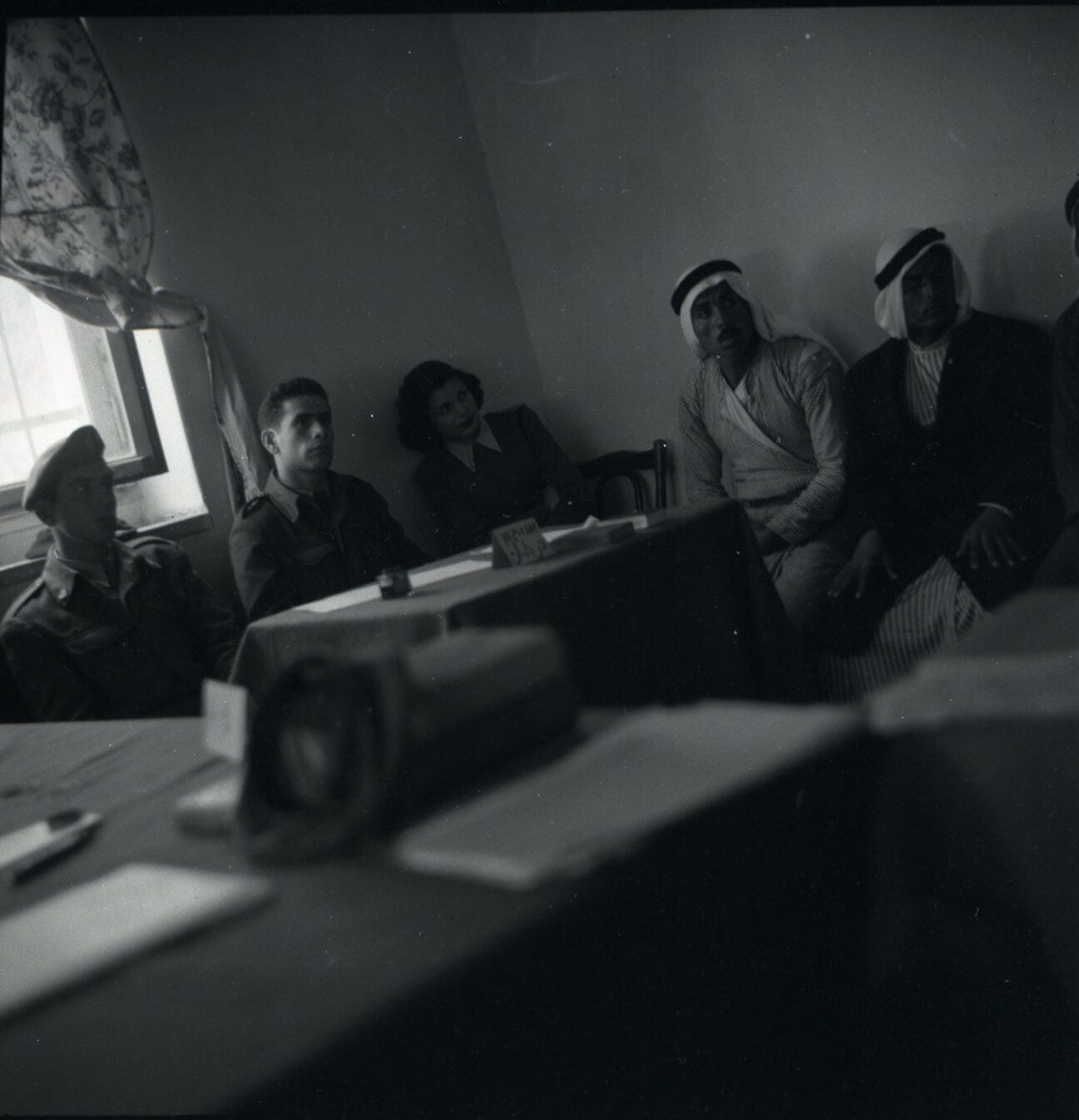
Once the door was opened, people rushed in like a flood. I was among them and was there for no reason but to pass the time and listen to the sessions which people in our village and the surrounding villages talked a lot about. I scanned the hall quickly and chose a bench in the back to sit on while the crowds continued to pour in. They sat in front of me on wood benches prepared especially for the occasion.
I cast an eye over the hall. I saw in the front the court platform, which consisted of a chair and a small bare table. The ground was covered with a heavy military mat. Between the platform and the audience, there was a thin wooden partition about one meter tall. It extended from one side of the hall to the other with an opening on one side used as a door. Almost in the middle of this wooden barrier there was another small table used by the translator and the typist. Two meters away from the typist sat the prosecutor, who had his own small table covered with a stack of papers and files. A group of police officers and army troops leaned on the wall next to the prosecutor. Equipped with rifles and pistols, they were ready to receive the judge and enforce his decisions regarding discipline inside the court. Between the typist’s table and the audience there was an empty space at the center of which was placed a wooden rectangular bench for the suspects. Next to the bench, there was an iron cage prepared for criminals and dangerous murderers.
The session was all set. The stillness would have been almost complete but for the disruption of the intense, nonstop rainfall, the rivulets running down the narrow, winding paths of the village and the wild gushes of wind that nearly crushed the walls of the courtroom. Because of the biting cold, I shrank in my place and wrapped myself with my heavy, brown coat. I then looked out the window to watch the falling rain drops and the eucalyptus trees, which were swaying in the air with fog concealing their upper parts. No sooner had a few minutes passed than we heard the sound of a car entering the yard. We saw the revered judge getting out of the jeep and walking towards his room in the court through the back door. The audience’s necks twisted in accordance with the judge’s movements. Their eyes examined him from head to heel.
Judge Malchu Kharusha Fishlishksey’s entrance into the hall was announced. The audience stood in respect. His Excellency walked towards the platform with slow, firm paces and sat on his chair, gesturing to the crowds to sit down; then he ordered the prosecution to present his cases.
The discussion of cases related to failure to respect the curfew lasted a long time. Then, a fourteen-year-old boy appeared. He was thin, head shaven. H[e] was named Ahmad Hasan Barakat but nicknamed Ziki Flamitiko Hasan. Terrified, shivering and without any parent or relative, he was led by two Arab police officers. He had spent two days under administrative arrest. His charge was leaving the place under curfew without a permit and travelling to Ramleh, situated to the east of the coastal city Jaffa.
When the two soldiers wanted to place him behind bars, the judge said gently, “No, don’t do that. It pains me to see a child placed where the criminals and murderers are.”
The two soldiers brought him nearer and sat him on a chair opposite the stand. It must be pointed out that the government encouraged the presence of crowds to avoid public criticisms. One claim was that these courts were held in closed rooms amid an atmosphere hostile to the Arabs.
His excellence, the judge addressed the boy in very lightweight Arabic, “Be relieved boy. Do not worry because the law will not harm you. We cannot jail you or fine you. The law does not allow this. We are a democratic country run by mercy and justice. Moreover, we take into consideration cases of minors. What is your name, son?”
“Ziko Flamitiko Hasan,” the boy answered.
“Your name is strange, boy, isn’t it?” the judge questioned.
“That is what people call me in the village. It is a nickname. Hasan is my father’s name.”
“Where is your father? Why has he not come with you to the court?”
“My father is dead, Sir.”
“Where is your mother?”
“She is dead, too.”
The judge said in surprise, “Where do you live? Who is your custodian?”
“My grandmother, Sa’dah Al-Mousa, your honor.”
Perplexed, the judge asked, “Why has she not come with you?”
“She is paralyzed.”
Signs of depression and dissatisfaction appeared on the judge’s face. He leaned back against the chair and went into deep thinking. He thought and thought and then said, “It disturbs me to see a boy your age with security allegations and yet without an escort holding his hand and accompanying him. We are a democratic, civilized state. I do not exaggerate if I say we are the oasis of democracy in the Middle East and a candle giving light to nations around us.”
He paused then addressed the boy directly, “Look around you, Ahmad. Do you see among the crowd a relative, a friend, or a neighbor whom we can call to sit next to you to ease you?”
Ahmad turned his face backward and cast an eye over the crowd. He looked left and right and suddenly he saw an uncle who must have come to entertain himself by attending the sessions, the notoriety of which had spread in the region. Ahmad said, “I see my uncle among the people.”
“Really, who is he?” asked the judge.
“My uncle Tahesh, Sir. There he is.”
The judge signaled to the uncle to approach him. The uncle walked towards the stand. The depression cleared from the judge’s face. His face broadened in a smile. He said, “Are you the boy’s uncle?”
“Yes, Sir.”
“What is your name?”
“Tahesh Al-Balbedie Al-Hindbendie.”
The judge asked, “What do you do?”
“A contractor, Sir. I build houses.”
“How is your work?”
“Work is much and the taxes are more.”
The judge laughed and said, “That is the condition of all of us.” He then paused and resumed his talk. “Your name is very unusual, my man. It seems you are from Al-Hind Bend.”
Tahesh answered, “My ancestors came many years ago from the desert of Belbend Al-Hindbend and resided in Palestine.”
“Most welcome, Tahesh. Stand near the boy and try to calm him as much as you can.”
Tahesh stood next to the judge Malchu Kharusha Fishlishksey during the session discussing the case of Ahmad Hasan Barakat, nicknamed Ziko Flamitiko Hasan. Addressing the boy, the judge said, “By your presence in Ramleh City without a permit, you are accused of violating material 2916, paragraph ‘c’ of the emergency system.”
Ahmad Hasan replied, “But I pick olives in Ramleh with a group of workers. Our boss obtained a collective permit for all of the workers in Ramleh. I am one of them and here is the permit, Sir. Our boss passed it to me upon learning about my trial.”
The judge took the permit and examined it carefully. He then said, “This permit gave you the chance to travel to Haifa only. Your presence in Ramleh is, therefore, a violation of the permit’s conditions, the security regulations and a threat to public security.”
At that moment, Tahesh, Ahmad’s uncle, stood and said, “With your permission, Sir, with your permission.”
“Speak up Tahesh. Say whatever you wish. I am all ears because we are a democratic state, which asserts freedom of speech and expression and believes in a man’s right for self-defense. Every citizen has the right to say what he pleases. Proceed.”
“With your permission, Sir. The boss expressed his readiness to come to court to deliver his testimony.”
The judge said, “The suspect should have submitted a written request to the court one week before the start of the trial. Now it is too late. Your request is denied.”
Tahesh begged, “Please Sir. I have another request.”
“What now, Tahesh?”
“I say the boy is young and ignorant of the laws.”
“Your request is denied. Not knowing the law does not relieve the suspect of responsibility.”
Then Tahesh answered, “With your permission, Sir. What I know is that obtaining a permit to exit a prohibited area allows a person to go anywhere in Israel as long as the destination is not closed or forbidden. What I also know through my ties with lawyers and experiences in courts is that the prohibition defined by the law relates to a certain spot of land rather than an Arab person, as it is known today.”
The judge said, “The court believes your claim is partly true but in the present case I see that Ahmad Hasan Barakat was found in Ramleh in violation of the conditions as defined by the permit, and so your objection is not accepted.” Then the judge resumed addressing both the suspect and his uncle, “Now stand up both of you: Ahmad Hasan and Tahesh.”
Ahmad stood up. The judge said, “Do you want to say anything before I recite the verdict, Ahmad?”
Ahmad was silent. So his uncle bent towards him and whispered in his ear, “Say, ‘Mercy, Sir.’” Following his uncle’s tip, Ahmad said, “Mercy, Sir.”
What about you, Tahesh? Do you want to say anything?”
Tahesh was confused. His tongue was tied, then fumbling for words, he stuttered, “Me, Sir?”
“Yes, you.”
“Your mercy, Sir.”
“Verdict: Taking into consideration your young age and good record, Ahmad Barakat named Ziko Flamitiko Hasan, you are charged to pay 100 [] pounds. In case you fail to pay, your uncle Tahesh Al-Belbend Al-Hind Bendy will be sentenced to jail for three months of hard labor in accordance with matter number 2916, paragraph 2 (c) of the emergency regulations.”
Upon hearing this verdict, Tahesh lost his senses. His vision grew dim and he stood rooted to the post, though his mind remained clear. He uttered no word and he made no gesture until eventually he cried aloud, “People of the world! Listen. The boy is sentenced and it is me who has to pay! Is that logical? Have you heard such a sentence before?”
“Yes. You must pay because you are his uncle. You are his custodian; isn’t he an orphan?”
Tahesh shouted in the judge’s face, “I entered the court as a visitor, not as a suspect or a criminal. This is injustice. In fact, this is racism, the act of a clown.”
As he verbally assaulted the court, two soldiers came quickly and took hold of him, asking him whether he preferred paying a fine or going to jail.
Eventually, Tahesh understood he had no choice but to pay the fine, and he departed aimlessly into the falling rain. All he could do was to curse the point at which he had entered the court. Rain continued to fall heavily.
Assadi, Jamal, and Saif Abu Saleh, eds. 2017. Short Fiction as a Mirror of Palestinian Life in Israel, 1944–1967: Critique and Anthology. New Studies on the Middle East. Peter Lang.