
bedouin poems
reading clinton bailey while unemployed for a week

As many already know, I had been frequenting Bedouin towns in the south since mid-November thanks to Ben Gvir’s unrelenting efforts to turn the Negev into the West Bank (or perhaps more accurate, reintroduce the martial law that existed here before 1967). These visits to Tarabin al-Sana, Hura, Kuseife, Segev Shalom and Lakiya marked the first time in months that I felt like a reporter, as opposed to a stenographer copying down WhatsApp statements sent out by the cops.
My travels unfortunately came to a sudden halt as I was forced to take a week-long break from work. I was initially bored, beset by anxiety about the news stories squandered in my absence. But I soon became accustomed to the free time and recalled how great it feels to be an unemployed college student. I stopped checking my phone each minute, tuned out of the news and spent most days reading in the National Library.
With the Negev wanderings still fresh in my mind, I picked up two Clinton Bailey books at the library. One was a study on the customary law of Negev and Sinai Bedouin, the other was a survey of their oral poetry, comprising 113 poems Bailey came across during his own travels spanning two decades.1
The latter book caught me completely off-guard. I had assumed the poems Bailey immortalized in his 1991 study would deal with centuries-old tribal warfare and raids. It turns out that a lot of them are modern, addressing the social consequences of the nation-state, forced sedentarization and tribal chieftains’ acquiescence to Israeli rule. I would like to share some with you here.
Just to be clear, Bailey was insistent that these poems rhyme in English and thus took his liberties with translation. My Arabic sucks but I’ve tried (and failed several times, as you’ll see) to note wherever there’s a line or turn of phrase that’s starkly different from the original idiom.
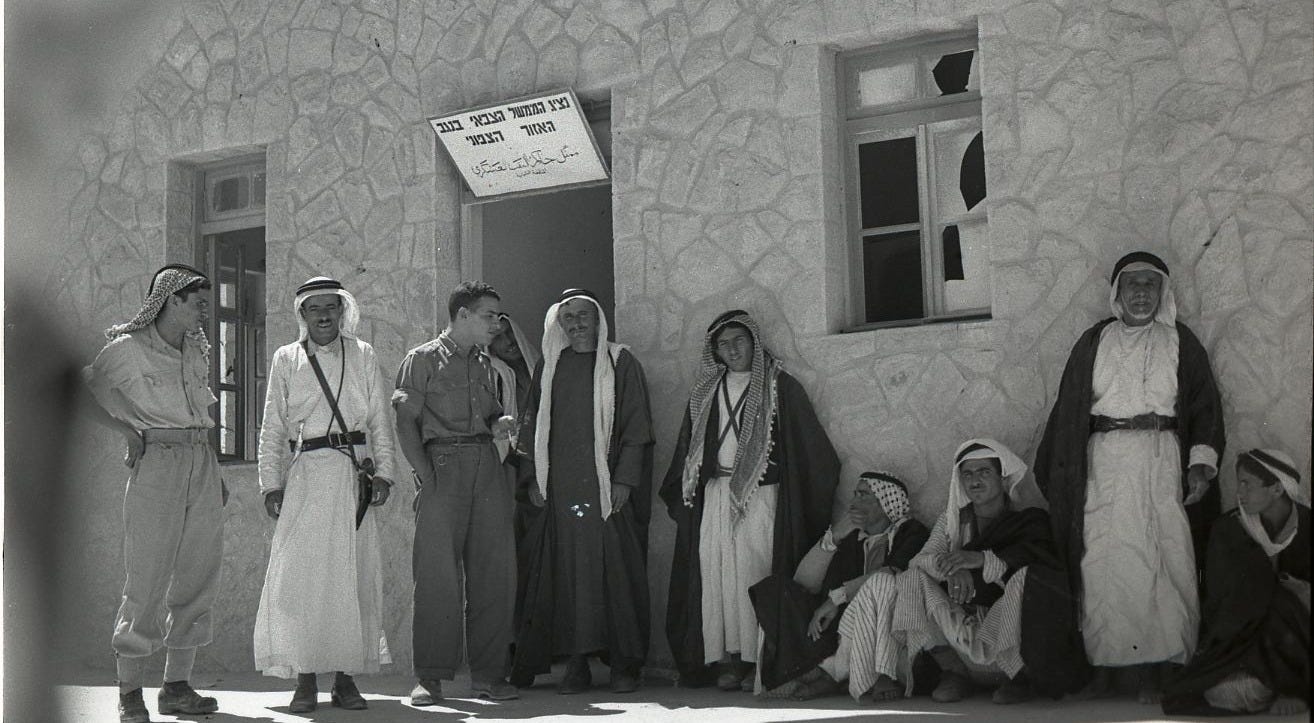
Even before British occupation, Bedouin tribes in the Negev and Sinai were not quite as “nomadic” as those in Arabia, Iraq, Syria and Jordan. Their shepherding activities meant most families migrated shorter distances (under 50km) and many even sowed crops. When the Ottomans systematized their land regime in 1858, many Bedouin farmers were able to gain usufruct rights from the sultan over certain parcels of land (this legal category is called miri).2 I bring this up because the nomadic label often gives way to false assumptions that these tribes were essentially rootless and estranged from the land they were living on.
After 1948, the vast majority of Negev Bedouin were expelled to the West Bank, Gaza, Transjordan and Sinai. Those who remained were boxed into the “sayig” — a closed military zone in the northern Negev — and put under martial law.3 Many farmers were stripped of their lands, shepherds were subject to stringent restrictions and the border with Egypt, now heavily fortified, led to a decrease in smuggling. The swift loss of livelihood forced many Bedouin to turn to pursuing wage labor within Israel.
This brings me to the first poem, by Iyad Awad Ibn Adisan of the Azazme tribe, an admonition against selling land to the Jewish Agency. He performed the poem for audiences at numerous encampments throughout the Negev in the 1940s, cautioning chieftains against this encroaching threat to the Bedouin lifestyle.
The poem — recited to Bailey by the poet’s brother, Suleiman, in 1972 — warns that the money gained from land sales offers only fleeting material comfort in exchange for one’s freedom. The poem ends with a jab at one of the sellers, al-Zirbawi, taunting that he supposedly no longer had any space to take a dump.
O Rider on one who keeps a fast pace,
As if she’d been pricked and appears to be leaping;Like a gazelle who’s on the lookout ahead of its herd,
As hunters it spies on the plain, and is stirred.O Rider, if you want to urge him to speed,
My advice is: don’t let the halter get freed.Stop off with our chieftains, each one of them brave,
Fellows sitting in council, you’ll find them all grave;You’ll hear a chief belch as he comes forth to greet,
A belt he won’t wear, having too much to eat.Say: ‘Last night, how I felt in my heart a great pain,
For the chiefs aren’t aware of what I would complain.I sighed when I saw them, their faces so cool,
Making deals in the market, led on like a fool.’They told: ‘Sell off your farmland, there’s some who’ll buy;
You’ll get all you want, for the price of land’s high.’Sell your freedom to raid virgin long-necked camels!
Sell pastures where camel herds graze without trammels!Yes, spend on yourselves for one month, maybe more;
Spend freely on clothes for a few night’s decor.Your sale in the end is of roots you’ll have torn;
You’ll yet wander ‘tween Egypt and Sham till you’re worn.The land that was spacious, yet narrow will be,
You’ll find nowhere to rest ‘tween the hills and the sea.Look at Ibn Sa’id and Rabi’a, O my!4
They’ve built houses of stone, painted red and so high!5They’ve wed daughters of peasants who spice spoiled meat
And spurned those whose fathers spice coffee-pots.Their wives stand around in a thin chemise gown,
Fried foods and soft bread are their only renown.Even Zirbawi this life couldn’t abide,
When, after shitting, it stuck to each side.
According to Bailey, the last few stanzas, with its references to spoiled meat, fried foods and soft bread, represent preconceptions about non-Bedouin Arabs. Namely, that their lack of livestock means they consume non-fresh, therefore unhealthy meat. Soft bread is another shameful marker of sedentary life, apparently.
The next one is by Azazme poet Suleiman Awad Ibn Adisan, the brother of the aforementioned Iyad. This poem was composed and recited in 1971 before senior IDF officers as a “panegyric” (but not really) during their ceremonial visit honoring the confederation’s chieftain Awda Abu Mu’ammar, for his success in enlisting tribesmen into the Israeli army.
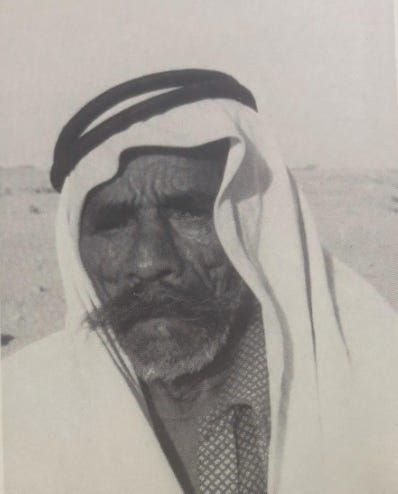
Knowing that the Jewish and Druze officers were unfamiliar with Bedouin dialect, Suleiman seized on the opportunity to ridicule Israeli government officials (and Arab heads of state) before his audience, which was mostly Bedouin, apart from the unwitting soldiers.
He pokes fun at then-prime minister Golda Meir who was, of course, a woman (“with obedience we would all be smitten”). He then moves onto then-defense minister Moshe Dayan — who imposed harsh restrictions on Bedouin grazing areas as IDF chief in the 1950s — with a sarcastic line: “And my rights he will always hold dear.”
I was saddened to learn the poet’s quip that the Azazme chief had “made jihad on the side of the Jew” was half-spoken and largely implied. The original Arabic is: لمّ ربعه للجهاد. I’d appreciate if someone could let me know how “ربعه” is used in this sentence because I have no clue. Bailey insists that the thrust of the gibe was perfectly clear to his audience.
I’ll begin by remembering the Lord.
Bring a pad, and some words we’ll record;
Fine words in the past I’ve had written.But fellows, please let me explain,
To lie is not something we deign;
And if from the truth we refrain,
Each lover of truth will be bitten.Of Golda Meir we should say,
Midst medals and crowns in array,
If she sent all her troops to the fray,
With obedience we would all be smitten.Now Moshe Dayan all revere,
To do battle he’s always in gear,
And my rights he will always hold dear;
No one’s been able to beat him.King Hussein always comes between foes
And brings all the nations repose;
For his fine inclinations we greet him.To Anwar Sadat we would say:
Why harp on what’s past every day?
Recall when Gamal6 passed away,
No one at all could retrieve him.For such is Palestine,
Where life in the past was just fine
[…]7
And we thanked and commended the Lord.Now our chief has a troop to inspect;
They joined not from force but respect;
May the Lord, Awda’s luck, not neglect,
His command we have never ignored.He has given us all that we own,
But we scoundrels are his, as we’ve shown;
And the Fates,8 may they leave him alone:
We ask God to ensure his reward.Hammad Abu Rube’a, he too,
(I believe what I say to be true)
Made jihad on the side of the Jew,
Sending men to the Suez Canal.But if I’m to tell the whole truth,
All of our chiefs are no use;
Their handing out permits a ruse
Lest the army their goat-herds assail.But by Ibrahim I would swear
That Israel’s rule one can bear
To the tall and the short it is fair:
In the end, each gets his without fail.
In addition to his veiled mockery of Israeli politicians, Suleiman also recited for Bailey a poem laying into the Military Governorate for its restrictions on shepherds, which forced many Bedouin to abandon their pastures in the central Negev. The Azazme poet was one of many shepherds whose flocks were seized by IDF trackers. He vented his frustration through verse.
In the 1950s, the enforcement of the shepherding restrictions fell to a sergeant-major named Shlomo Kadosh. The name “Kadosh” (or “Kadush” as it is transliterated here) became synonymous with “cunning and abitrariness” among the Bedouin, Bailey writes. The army official was infamous for using Bedouin trackers to ferret out herdsmen in the Negev, whose expanses were difficult for Jewish officials to navigate.
Any land where Kadush is found,
Though high with grass, is out of bounds.He fills command-cars full of scum,9
Over every mountain ridge they come.Don’t let your fez be cocked and sway;
Each man has a fate that awaits him!I brought forth a camel, the pride of the herd,
A mare never mated by an untrammelled stray.Behind the saddle my rifle was bound:
On my life, it’s shot could bring anything down.And a water-skin, stitched so tight at the fold,
That its water, so cold, formed crystals of ice.O girl, weave no curtain for a tent that’s all rags
Now that we’ve put our honor behind.
This next poem was composed in Israeli-occupied Sinai by Atiyya Mizan Awwad of the Alegat confederation. It was recited to Bailey in 1971 at Abu Rudeis, in the southwestern part of the peninsula, and meant as a satire about the hiking cost of living, a direct result of inflation racking Israel.
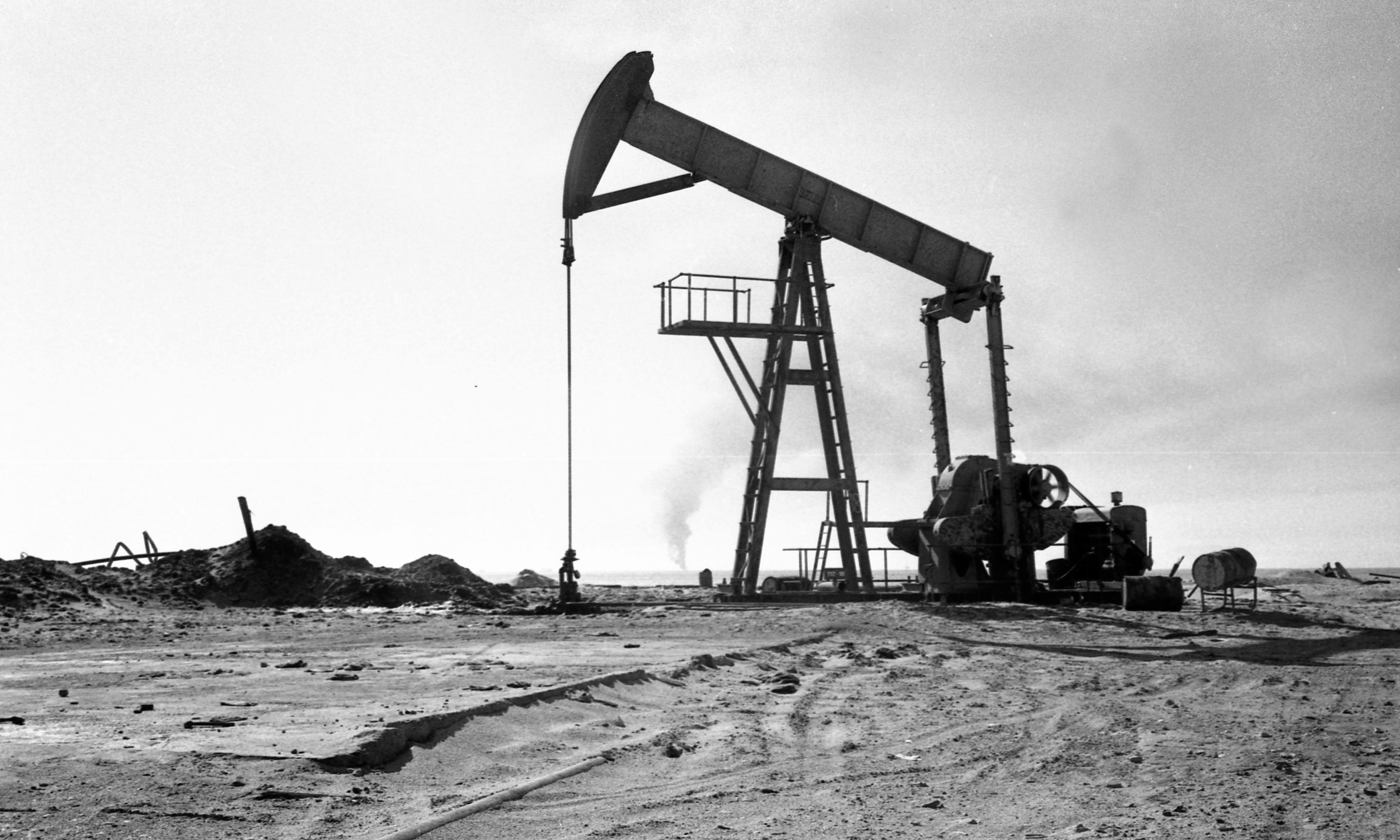
The protagonist, a worker in the Abu Rudeis oilfields, complains about the meager earnings he brought home to his family after a week’s worth of labor. The poem ends with him trying to console his angry wife, assuring her that even the tribal chiefs are struggling to get by, since hashish smuggling has also come to a halt.
I want a pack of cigarettes from old Hasuna’s shop,
Where goods stand piled high in stacks, right up to the top.
We all know every client well, the boss to some said,
His pen moved like a barber’s razor on a shaven head.
A sack of flour, a box of goods, will cost a hundred pounds—
And then at home his wife complains, and he asks why she hounds
She answers: After nights away, you can’t bring more than this?
He says: If you saw us at our work, you’d think we’ve gone amiss.
The whole day long we drown in oil reaching to our eyes,
No longer knowing what we are, as time, God curse it, flies.
She asks: But what about our chiefs, their teeth are bright with gold?
He says: That too’s from long ago, when drugs they bought and sold.10
It’s always exciting to come across art that portrays a reality I’m somewhat familiar with. Bailey’s study helped me frame in recent history what I’ve been seeing and hearing in Negev Bedouin towns over the past few months. At the very least, it’s cemented for me that the logic underlying the Ben Gvir-led raid on Tarabin al-Sana is not unique to his tenure, and rather sprung up decades prior when Arabs were subject to martial law.
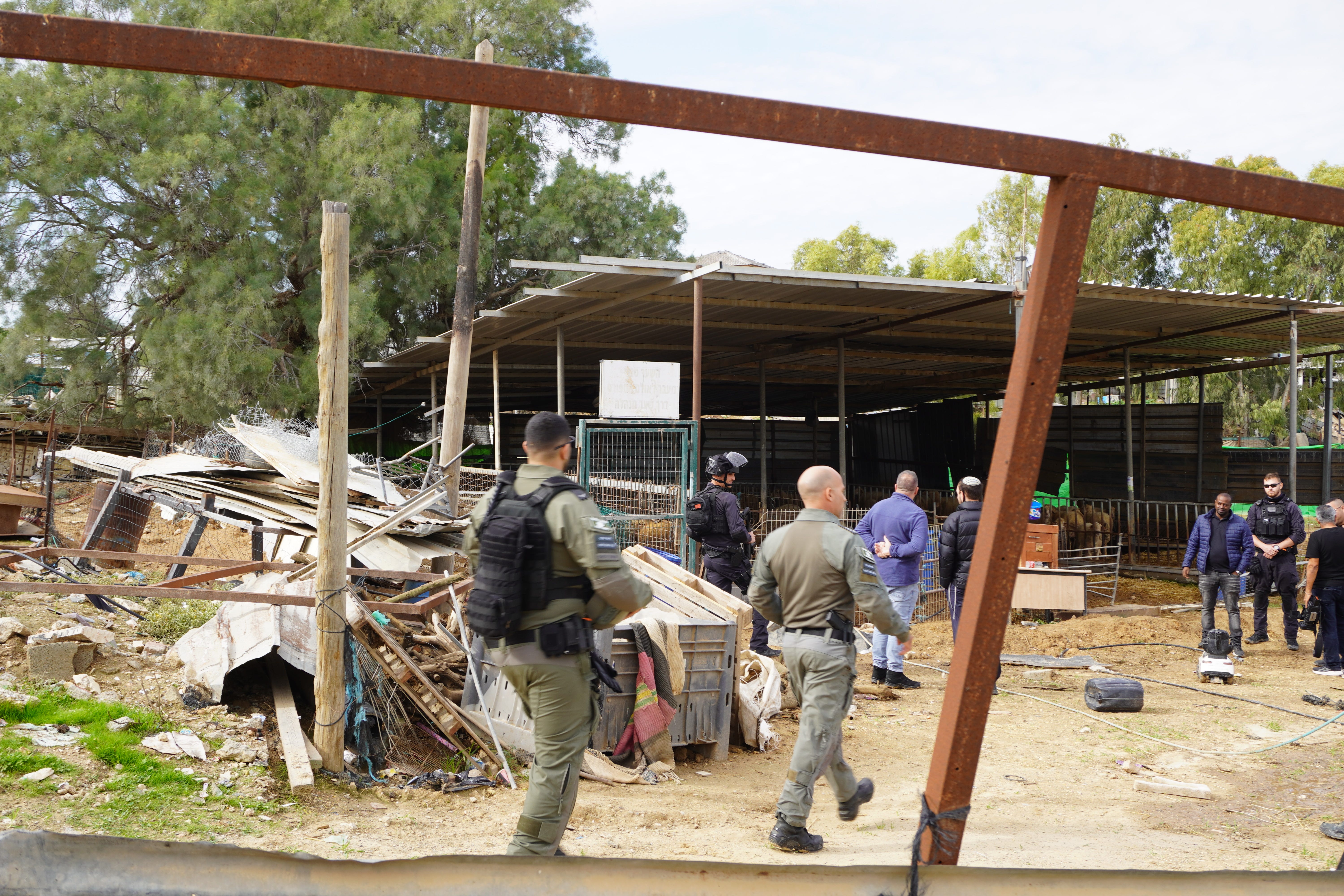
During my first visit to Tarabin, I hung out with a shepherd named Nasser to whom Ben Gvir paid a surprise visit, flanked by over a dozen of his National Guard troops. Of course, they landed on Nasser’s house at random, simply because the police minister passed by on the road. The forces poured into his backyard, heavily-armed men gathered under the awning of the sheep pen and an Agriculture Ministry official threatened to seize his flock, accusing the shepherd of not having immunized the animals.
It’s worth noting that Nasser, due to the same restrictive grazing laws mentioned by Bailey, has to haul his sheep to Ashkelon each day. For decades, these seemingly mundane regulations have been used to control Bedouin livelihoods.
Finally, this is tangential but I should have known the Tarabin tribe also exists on the other side of the Egypt-Israel border. There is an entire chapter in the book dedicated to the work of this one poet-smuggler from Sinai, a Tarabin tribesman named Anez abu Salim al-Urdi.
The well-respected smuggler was jailed by Egyptian authorities for fifteen years. During his sentence, he recited poems — detailing prison life, lamenting the unfaithfulness of his wives and unsettled smuggling accounts — to literate inmates and visitors. Eventually, these poems trickled out beyond the prison walls and made their way to his family and friends. Anez also received poems in jail by those who sought to either confront him or inform him of current events.
I have yet to finish this chapter since I don’t own Bailey’s book and can only read it at the library. But I probably won’t get to it for a while, since I return to work tomorrow. It’s already 2:30 a.m, so I better head to sleep now. Goodnight.
The field interviews he conducted span from 1968 to 1988. Bailey, Clinton. Bedouin Poetry from Sinai and the Negev. Clarendon Press, 1991.
A 1945 survey commissioned by Mandate authorities calls the Bedouin “keen farmers” and notes that they would farm wherever possible in the northwestern Negev, the plain region home to some 1.6 millions dunams (1,640 km²) of cultivatable land. The report estimated that Bedouins were tilling most of this land, except for the 90,000 dunams (90 km²) of Jewish agricultural land. Government of Palestine, A Survey of Palestine, Prepared in December 1945 and January 1946 for the Information of the Anglo-American Committee of Inquiry, (Jerusalem, Government Printer, 1946), Vol. 1, 370.
Only 11,000 Bedouin remained within Israeli borders, from original population of 65-95,000.
Referring to Salama Ibn Sa’id and Id Ibn Rabi’a of the Azazme confederation, who both sold land to the Jewish Agency. The original Arabic is not “look at” but “think of” (فكرو).
The Arabic term used here is قصور which is the plural for “palace.” Apparently this is how Bedouin referred to any built structure during the time of this study. In this line, the poet is referring to the immigrant housing that popped up post-1948 in Jewish agricultural communities across the northwestern Negev.
Refers to Egyptian president Gamal Abdel Nasser, who preceded Sadat before dying of a heart attack.
Bailey’s note: When asked for this apparently missing line, the poet protested that it had never existed. There are two possible explanations: either he considered it prudent not to record the rhyme-word, which was probably “devils” (Arabic: شياطين) referring to Israel; or he deliberately omitted the line from his original composition, as the line would obviously have ended with “devils",” its omission might have been stronger and more humorous.
“Fates” apparently refers to death in this case. The Arabic is منايا.
“Scum” refers to the Bedouin trackers persecuting their kinsmen. The line in Arabic is: دبّ الكمنكر عيال هبوش. There are a few things I want to note, first off “كمنكر” is from English as far as I know (“command-car”). Second, it seems to me that the translation of “عيال هبوش” — supposedly “scum” — is more literally “rabble of children” from what Bailey himself noted at the end of his book, but what do I know.
The word for drugs is حنونة referring to flowers, and by extension, hashish.